
Durability Benchmark: How Many Wash Cycles Should Scrubs Survive?
Durability Benchmark: How Many Wash Cycles Should Scrubs Survive?
If you’ve ever had a scrub top fade, pill, or lose its shape way earlier than expected, you already know the real problem: durability isn’t a “nice-to-have.” It’s money, time, and trust—especially when you’re ordering for a clinic group, hospital program, or laundry rental service.
This guide gives you a practical durability benchmark: how many wash cycles scrubs should survive, what tests to ask for, and how to compare suppliers without guessing. (And yes—two scrubs can look identical on day one and perform totally differently after 30 washes.)
If you’re still deciding what kind of partner you need, start with medical scrubs manufacturer.
Who this is for (and when to use it)
Use this benchmark when you are:
-
sourcing scrubs for a hospital, clinic chain, or nursing group
-
building an OEM program where you need repeatable quality across reorders
-
buying for rental/industrial laundry (where scrubs live a much harder life)
-
comparing two fabrics and trying to avoid “looks good, wears out fast”
The best time to use it is before sampling (so you can choose the right fabric direction) and again before bulk (so you can lock in test requirements in writing).
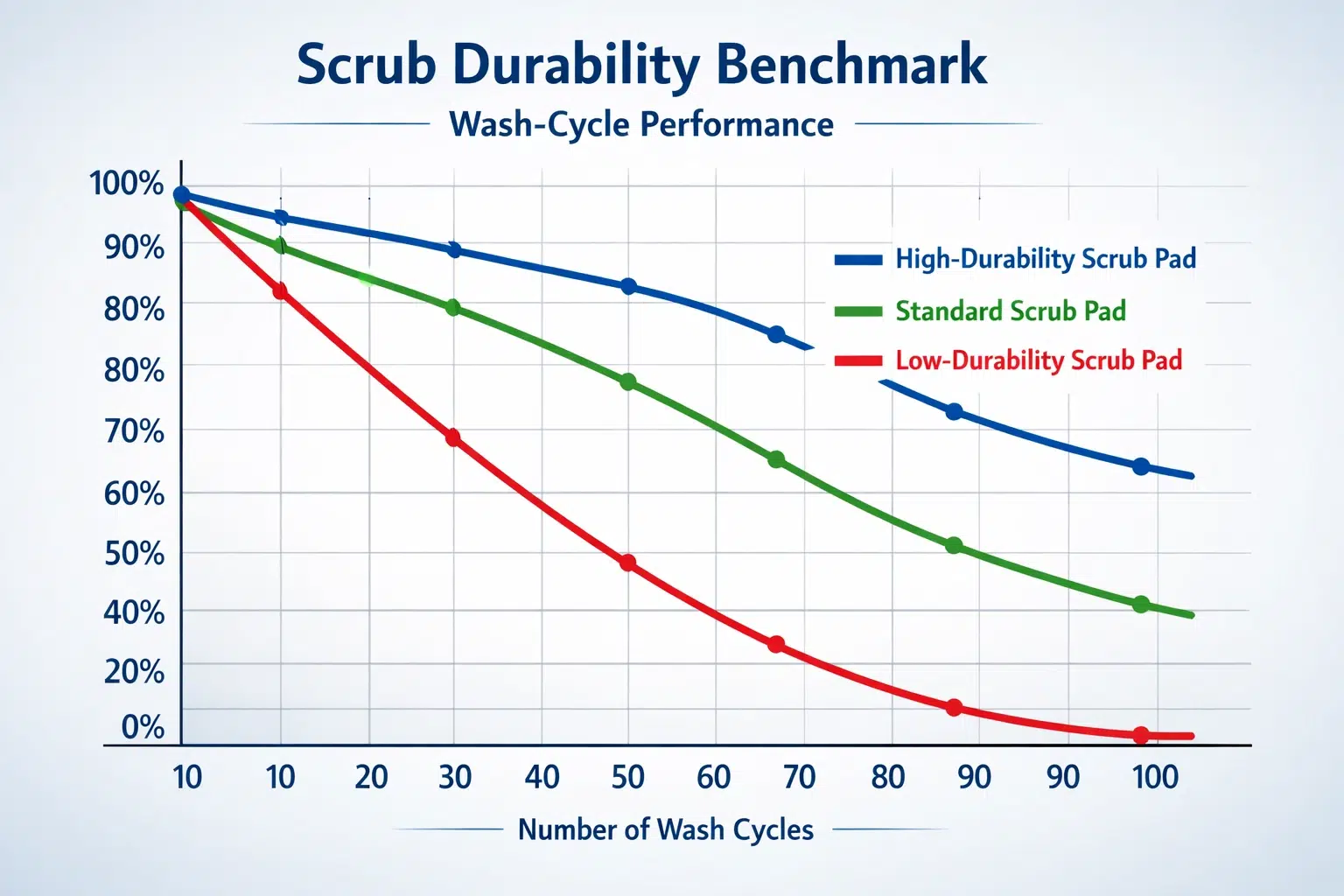
A realistic benchmark: how many wash cycles?
There isn’t one magic number for every buyer, but here’s a practical way to think about it:
-
Light/standard clinic use: aim for 50+ home-wash cycles without major fading, heavy pilling, or losing shape.
-
Busy hospital use: aim for 75+ cycles with stable color and seams holding up under constant movement.
-
Rental/industrial laundry use: aim for 100+ industrial laundry cycles, and confirm the wash chemistry (chlorine/bleach or not) because that changes results.
Important: the number itself isn’t the “standard.” The standard is that everyone tests and reports results under the same laundering method and cycle count.
The 4-step durability check (use this with any supplier)
Step 1: Define your wash reality
Ask your team (or your customer) three quick questions:
-
Is washing home laundry or industrial laundry?
-
Do they use chlorine/bleach or not?
-
What are the biggest complaints today—fading, pilling, shrinkage, seam failure, or “feels rough”?
Write the answers down. This becomes your durability “brief.”
Step 2: Choose 1–2 fabrics that match the brief
Most durability failures come from fabric mismatch, not sewing.
If you’re building a spec, use OEM medical scrubs as the reference point for what to lock: blend, GSM, weave, stretch, and finishing.
Step 3: Ask for proof (not promises)
When a supplier says “our fabric is durable,” follow up with:
-
What test methods do you use for industrial laundering and colorfastness?
-
How do you report shrink/shape change?
-
Do you have results from similar programs?
You’re not trying to embarrass anyone. You’re trying to avoid buying blind.
Step 4: Bake the benchmark into sampling
Don’t wait until bulk to talk about durability.
Ask the supplier to (a) provide test results for the same fabric quality, or (b) run agreed wash-cycle testing before you lock the bulk order.
Durability scorecard (report-style, not “made-up scoring”)
For hospital/industrial laundry, avoid a single “1–5 overall score.”
A more credible approach is a report-ready scorecard: each item ties to a standard test method, and the output is a grade/value you can paste from a lab report.
Tip: Fill Requirement based on your buyer spec. Fill Result using the actual test report.
| Test item | Standard (ISO) | Hospital/industrial laundering condition | Report output (typical) | Requirement (spec) | Result (lab report) |
|---|---|---|---|---|---|
| Industrial wash & finish protocol (applies to all “after wash cycles” items) | ISO 15797 |
Programme: ____ Drying/finishing: ____ Cycles: 25 / 50 / 75 / 100 (circle) |
Programme ID + cycles (n) Dryer/finisher settings |
||
| Dimensional change (shrink/shape stability) | ISO 5077 | After ISO 15797 cycles: ____ |
Length change (ΔL): ___ % Width change (ΔW): ___ % |
||
| Colorfastness to industrial laundering | ISO 105-C12 + ISO 105-A02/A03 |
Procedure per ISO 105-C12 (industrial laundering) |
Color change (A02): Grade ___ (1–5) Staining (A03): Grade ___ (1–5) [adjacent fabric as reported] |
||
| Colorfastness to rubbing (dry & wet) | ISO 105-X12 | Dry & wet rubbing per ISO method |
Dry rubbing: Grade ___ (1–5) Wet rubbing: Grade ___ (1–5) |
||
| Pilling / fuzzing resistance | ISO 12945-2 | Report rub cycles used: ____ |
Pilling grade: ___ (1–5) After ____ rubs |
||
| Abrasion resistance (Martindale end point) | ISO 12947-2 | Test pressure/abradant per report |
Cycles to breakdown: ___ cycles End point definition: ____ (as report) |
||
| Tensile strength (fabric breaking force) | ISO 13934-1 | Warp & weft specimens |
Max force (Warp): ___ N Max force (Weft): ___ N Elongation at max force: ___ % |
||
| Tear strength (trouser tear) | ISO 13937-2 | Warp & weft directions |
Tear force (Warp): ___ N Tear force (Weft): ___ N |
||
| Seam strength (seam maximum force) | ISO 13935-2 | Direction: Warp / Weft (as tested) |
Seam max force: ___ N Failure mode/location: ____ |
||
| Seam slippage (seam opening at fixed load) | ISO 13936-2 | Load: ___ N | Direction: Warp / Weft |
Seam opening: ___ mm At load: ___ N |
||
| Visual appearance after industrial laundering (optional, but common in reports) | ISO 15797 | After ISO 15797 cycles: ____ | Notes/photos: creasing / puckering / overall appearance (as reported) |
If two quotes are close, this scorecard is what usually shows the real difference—because it removes “trust me” language.
3 common mistakes buyers make
1) Using the wrong wash benchmark
A “50 washes” promise means nothing if your reality is industrial laundry with harsh chemicals. Always align the benchmark with your wash environment.
2) Focusing on fabric only, ignoring construction
Even great fabric fails if stress points are weak: pocket corners, crotch seams, side slits, waistband joins. Ask how they reinforce high-stress areas.
3) Treating durability like a marketing claim
“High quality” isn’t a spec. Durability needs:
-
a target (wash cycles + wash type)
-
measurable checks (color, pilling, shrink, seams)
-
a reportable format (grades/values)
If it’s not written down, it’s not real.
Want the full durability checklist + RFQ wording?
If you want the editable durability checklist (including what to request in an RFQ and what ranges to confirm during sampling), use:
Request a quote / project discussion
In your message, include:
-
your wash method (home vs industrial)
-
whether chlorine is used
-
your target wash-cycle benchmark
We’ll reply with a clean checklist you can use to compare suppliers consistently.