
Bulk Pricing 101: How Scrub Factories Quote (Cost Breakdown)
Bulk Pricing 101: How Scrub Factories Quote (Cost Breakdown)
If you are sourcing medical uniforms for a hospital, a brand, or a large-scale distributorship, the question isn’t just “What is the price?” but “How did we get to this price?” Transparency in a factory quotation is the foundation of a reliable partnership.
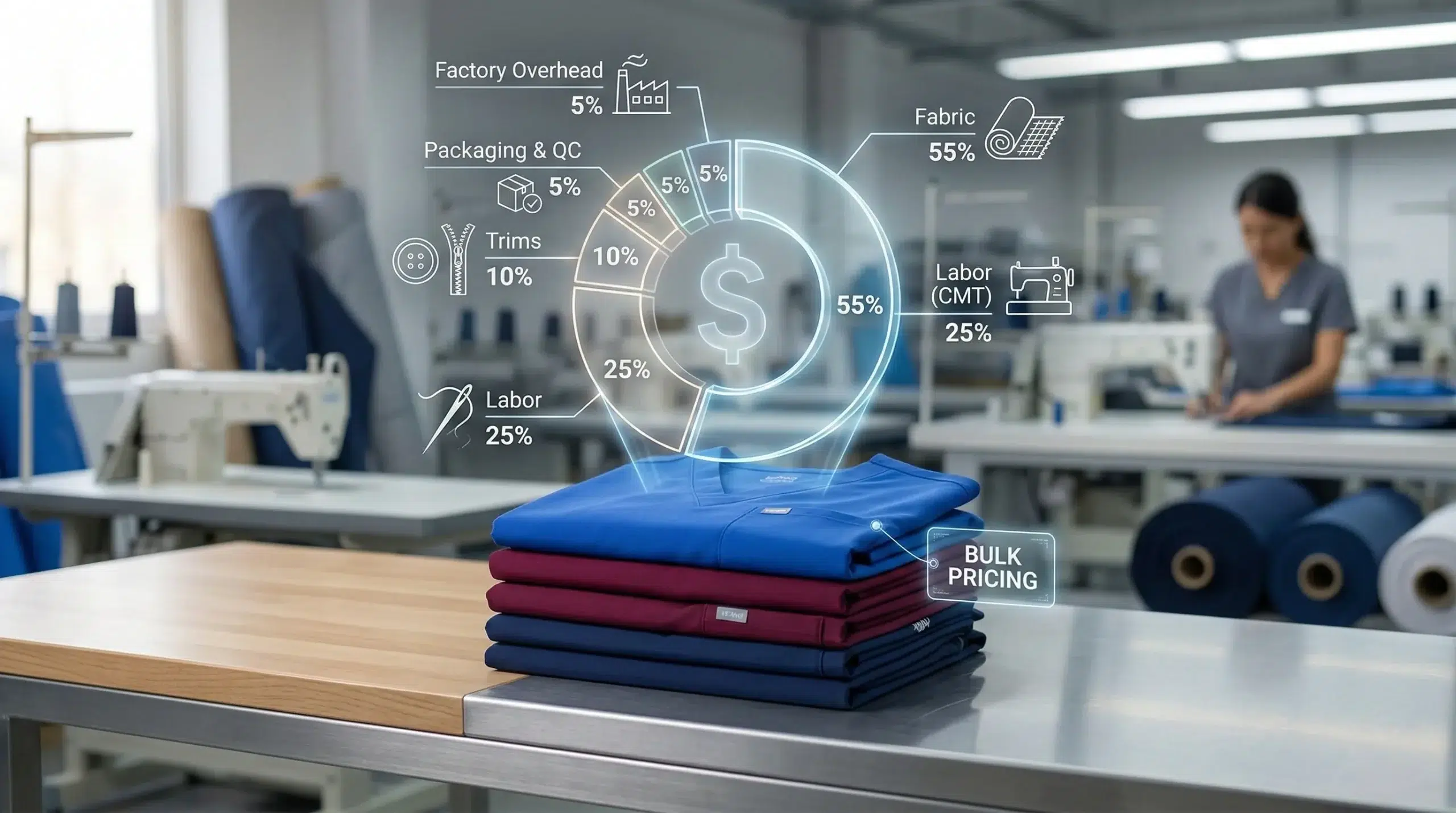
The Short Answer: A standard scrub set price is primarily driven by fabric weight (GSM) and composition, the complexity of the garment construction (number of pockets and reinforcement stitching), and the total order volume (MOQ). For a high-quality poly-rayon-spandex blend, you are typically looking at a factory cost where fabric accounts for 50-60% of the total, labor for 20-30%, and the remainder split between trims, packaging, and logistics. Understanding these levers allows you to optimize your budget without sacrificing the durability your healthcare professionals rely on.
The Anatomy of a Scrub Quotation
When you buy scrubs in bulk, a factory doesn’t just pull a number out of thin air. We use a formulaic approach to ensure the quote is sustainable for production while remaining competitive for your market. Here is the breakdown of what actually influences your bottom line.
1. Fabric: The Lion’s Share
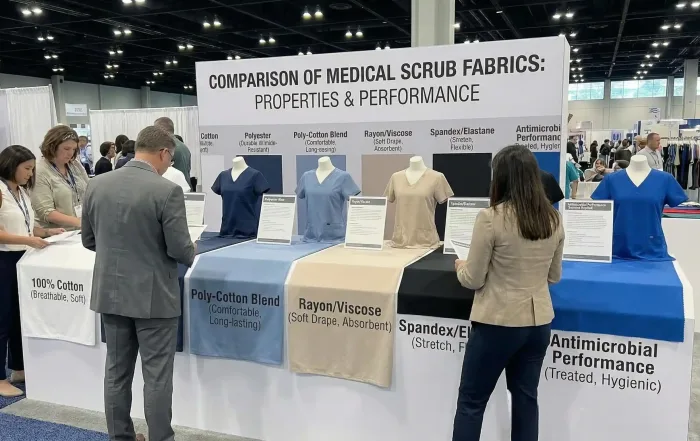
Fabric is almost always your largest cost driver. A basic 100% polyester scrub is significantly cheaper than the modern “4-way stretch” blends (typically Polyester/Rayon/Spandex).
-
Weight (GSM): A higher GSM (grams per square meter) means a thicker, more durable fabric, but it also increases the cost per yard.
-
Functional Finishes: If you require antimicrobial coatings, fluid-resistant barriers, or moisture-wicking technology, expect the fabric cost to rise by 10-20%.
2. Labor and Construction Complexity
Not all scrubs are created equal. A simple V-neck top with one pocket is fast to sew. A “jogger style” scrub pant with five pockets, reinforced seams, and a knitted waistband requires significantly more “minutes on the machine.” As a professional medical scrubs manufacturer, we calculate labor based on the Standard Allowed Minutes (SAM) required to finish a garment.
3. Trim and Branding Details
While they seem small, “trims” add up. This includes:
-
YKK vs. generic zippers.
-
Custom silicone-dipped drawstrings.
-
Woven brand labels and heat-transfer size tags.
-
Individual polybagging vs. sustainable paper packaging.
Factory Cost Breakdown Table
To give you a clearer picture, here is a representative breakdown of a mid-to-high-end scrub set (Top and Bottom) for an order of 1,000 sets.
| Cost Component | Percentage of Total | What Affects This? |
|---|---|---|
| Main Fabric | 55% | Composition (Rayon %), GSM, Color fastness requirements |
| Labor (CMT) | 25% | Pocket count, stitching style (flat-lock vs. overlock) |
| Trims & Accessories | 10% | Zippers, drawstrings, elastic bands, custom tags |
| Packaging & QC | 5% | Inspection levels, polybag thickness, shipping cartons |
| Factory Overhead | 5% | Sampling, administrative costs, compliance audits |
The Impact of MOQ on Your Quote
In the garment industry, “Volume is King.” When you work directly with a medical scrubs factory, the MOQ (Minimum Order Quantity) exists because of fabric dyeing minimums and machine setup times.
Buying 500 sets vs. 5,000 sets changes the price for two reasons:
-
Fabric Wastage: Cutting 5,000 sets allows for much better “marker efficiency” (using more of the fabric roll with less scrap).
-
Efficiency: Sewers become faster after the first 200 units. On a small run, you are paying for the “learning curve” of the production line.
How to Evaluate a Quote (Beyond the Bottom Line)
It is tempting to simply choose the lowest bidder. However, in the B2B space, a quote that is 20% lower than the market average usually indicates one of three things:
-
Inferior Fabric: The fabric might look the same but will pill, fade, or shrink after five industrial washes.
-
Lack of Compliance: The factory may not be following fair labor practices or environmental standards (which puts your brand at risk).
-
Hidden Costs: The quote might not include duty, port fees, or final QC inspections.
Always ask your supplier for a “Cost Breakdown Sheet” rather than a single lump sum. A transparent factory will have no problem showing you where your money is going.
FAQ
Why does the price change between colors?
Light colors (like white) sometimes require thicker fabric to prevent transparency, while very dark or vibrant colors (like Royal Blue or Burgundy) may require more expensive dyes to ensure color fastness.
Can I lower the price by providing my own designs?
Yes. Providing a complete Tech Pack (Spec Sheet) reduces the time we spend on sampling and development, which can often lead to a more favorable initial quote.
Does bulk pricing include shipping?
Usually, factory quotes are FOB (Free On Board), meaning the price covers the cost of getting the goods to the nearest port. You will need to budget separately for sea or air freight and import duties.
Ready to Optimize Your Sourcing?
Navigating factory quotations can be complex, but you don’t have to do it alone. Whether you are looking to refine your current pricing or starting a new private label project, we provide transparent, itemized quotes to help you make informed decisions.
Contact Us Now>>>Contact Us
Learn more about us>>>LANO SCRUB MANUFACTURER